Overcoming Overconfidence Bias: A Trader's Silent Nemesis
After a significant market event, whether it's a budget announcement, a central bank policy decision, or an earnings report, traders often find themselves at a crossroads of emotion. Some might feel an exhilarating sense of invincibility, thinking, "I nailed that call!" Others, perhaps after a misstep, might be convinced they're "due for a comeback" and "know exactly what happens next." While these feelings seem disparate, they share a common, subtle, and often dangerous root: overconfidence bias.
At Trade Encore, we understand that successful trading isn't just about market analysis; it's profoundly about self-awareness and managing your own psychology. Overconfidence, a cognitive bias that leads us to overestimate our abilities, knowledge, and the accuracy of our predictions, is one of the most insidious threats to a trader's capital and long-term success.
What is Overconfidence Bias?
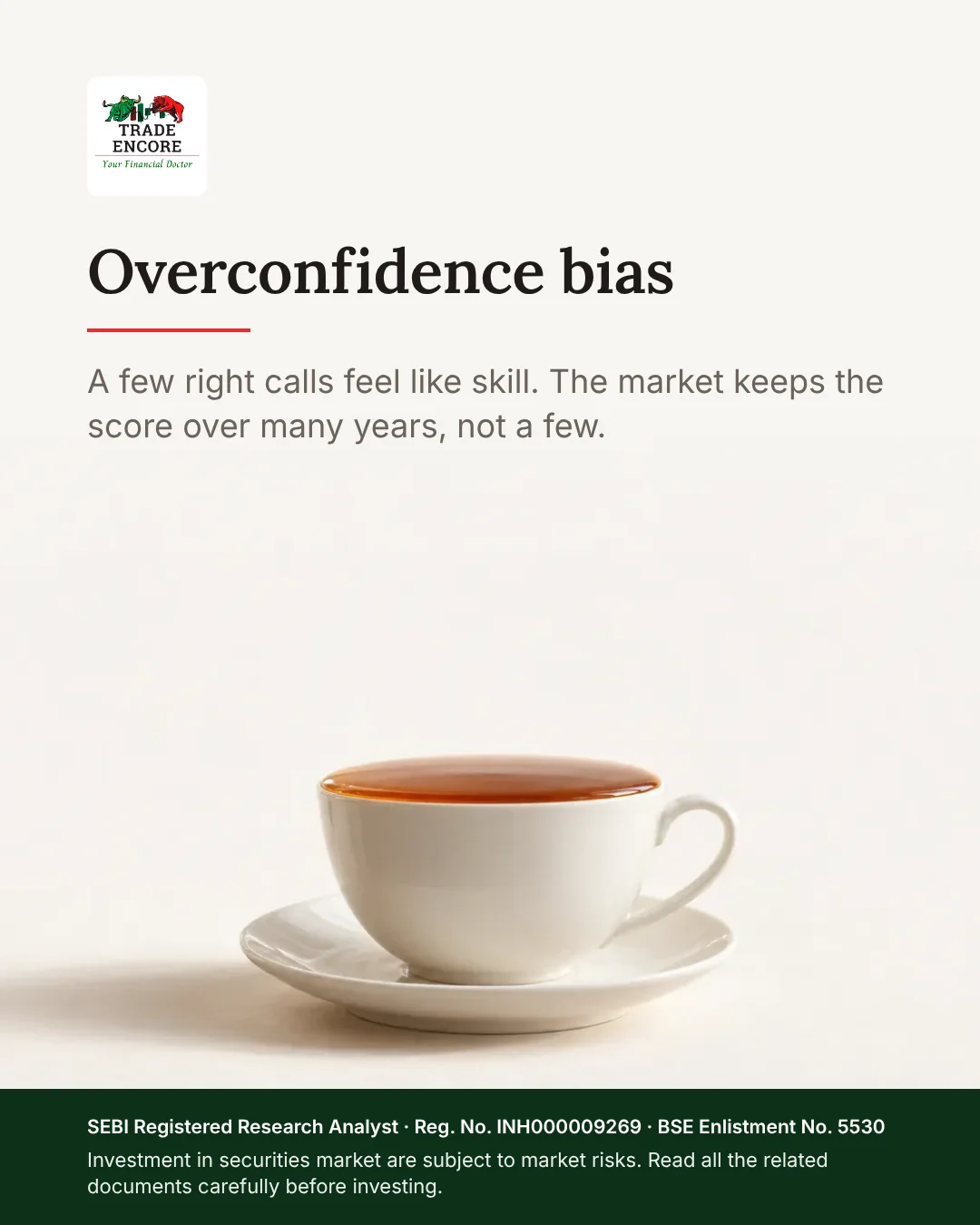
Overconfidence bias isn't necessarily about arrogance. It's a fundamental psychological trait where individuals have an unwarranted belief in their own judgment. In the context of financial markets, it manifests as an inflated sense of certainty about future price movements, the efficacy of a particular strategy, or one's ability to consistently pick winners. It's a false sense of certainty that often stems from a short streak of successful outcomes, rather than a deep, statistically sound understanding of probabilities.
Think about it: when you've had a few good trades, your brain rewards you with dopamine, creating a positive feedback loop. This natural human response can trick you into believing your recent success is solely due to your superior skill, rather than acknowledging the role of market conditions, luck, or simply the statistical probability of a winning streak.
A weird thing happens after a few good calls.
We stop respecting risk.
Not loudly. Quietly.We increase size.
We take trades faster.
We stop doing the boring checks… because “we already know”.That’s overconfidence bias.
It’s not arrogance. It’s a false sense of certainty that comes from a short streak.
The Silent Erosion: How Overconfidence Undermines Your Trading
The insidious nature of overconfidence lies in its quiet operation. It doesn't announce itself with fanfare; instead, it subtly alters your trading behavior, often leading to a gradual erosion of discipline and risk management. Here’s how it typically manifests:
- Disrespecting Risk: After a series of wins, your perception of risk diminishes. The fear of loss, a natural protective mechanism, recedes. You might start taking on trades with higher volatility or lower probability without adequate analysis.
- Increasing Position Size: This is arguably the most dangerous consequence. Convinced of your infallibility, you might increase your trade size significantly, believing that "this time it's different," or that "this setup can't fail." While a larger position amplifies gains when you're right, it exponentially magnifies losses when you're wrong.
- Faster Decision-Making: The meticulous process of analysis, planning, and waiting for confirmation starts to feel like a drag. Overconfident traders often rush into trades, skipping critical steps because they "already know" what's going to happen.
- Skipping Due Diligence: The "boring checks"—like reviewing fundamentals, re-evaluating technical indicators, checking news, or confirming your entry/exit strategy—are deemed unnecessary. This leads to uninformed decisions based on gut feeling rather than objective criteria.
- Ignoring Contradictory Information: Overconfident individuals tend to seek out information that confirms their existing beliefs (confirmation bias) and dismiss information that contradicts them. This creates a dangerous echo chamber in their own minds.
The market is a master of humility. It cares nothing for your past successes or your current feelings of certainty. It operates on probabilities, and every trade carries inherent risk. Ignoring this fundamental truth is a recipe for disaster.
Practical Habits to Keep You Grounded
Combating overconfidence requires conscious effort and the implementation of disciplined habits. Here are two powerful techniques to integrate into your pre-trade routine, ensuring you remain objective and grounded:
1. The 30-Second Base-Rate Check
Before committing to any new trade or investment decision, take a mere 30 seconds to objectively assess the probabilities based on your own historical data. This isn't about gut feeling; it's about confronting reality with data.
- How often does this setup actually work (in your own history)? Go back to your trading journal. If you've traded this exact setup 100 times, how many were profitable? Is it 60%? 70%? Or closer to 40%? Understanding your personal win rate for specific setups provides a crucial reality check.
- What’s the average damage when it fails? When this setup *does* fail, what's been your average loss? This helps you quantify the potential downside and set realistic stop-loss levels.
- If this fails today, will it hurt my month? This question forces you to consider the impact of a single losing trade on your broader financial goals. If the potential loss from this trade, combined with other potential losses, could wipe out a significant portion of your monthly or quarterly gains, it's a clear signal to rethink your position size or even the trade itself.
This quick check forces you to move beyond the emotion of the moment and ground your decision in actual, measurable performance data.
2. The Tiny Pre-Mortem
A "pre-mortem" is a foresight exercise where you imagine a project or decision has already failed and then work backward to determine why. For trading, it's a powerful way to identify potential pitfalls before they materialize.
- "Imagine this goes wrong. What is the most likely reason?" Before you place that trade, take a moment. Close your eyes. Envision the trade going completely against you. What went wrong? Did you miss a key economic announcement? Was there unexpected news about the company? Did the technical pattern fail spectacularly? Did you misinterpret a signal? By actively contemplating failure scenarios, you prepare yourself for them and can potentially mitigate their impact. This exercise encourages you to look for disconfirming evidence and consider alternative outcomes, which overconfident traders often ignore.
These simple habits act as mental circuit breakers, preventing your emotional state from overriding your logical, disciplined approach to the markets.
The Real Danger: Sizing Up After Wins
The social media post highlighted a critical truth:
Overconfidence doesn’t kill you on the day you feel confident.
It kills you on the day you size up.
This statement encapsulates the ultimate risk. A small, well-managed loss is part of trading. But an oversized loss, driven by an inflated sense of certainty, can decimate your capital, destroy your confidence, and even force you out of the market. The market is full of stories of traders who had a fantastic run, only to give back all their profits and more by taking one or two overly aggressive, overconfident positions.
Remember, consistency in trading comes from managing risk, not from predicting the future with certainty. Your edge is in your process, your discipline, and your ability to adapt, not in your temporary feeling of invincibility.
Conclusion: Embrace Humility, Cultivate Discipline
Overconfidence bias is a natural human tendency, but in the unforgiving arena of financial markets, it's a luxury you cannot afford. By understanding its manifestations and actively implementing strategies like the 30-second base-rate check and the pre-mortem, you can cultivate the humility and discipline necessary for long-term trading success.
True confidence in trading stems not from a winning streak, but from a robust process, disciplined risk management, and a realistic understanding of probabilities. Stay grounded, respect the market, and let your data guide your decisions, not your fleeting emotions.
Question: Do you notice yourself sizing up after wins? Share your experiences and strategies for staying grounded in the comments below.
Disclaimer: This blog is for educational and informational purposes only. It does not constitute investment advice. Investment in securities market is subject to market risks. Read all related documents carefully before investing. Trade Encore — SEBI Reg: INH000009269