Tax Loss Harvesting Before FY 2025–26 Closes: Today Is the Last Trading Day
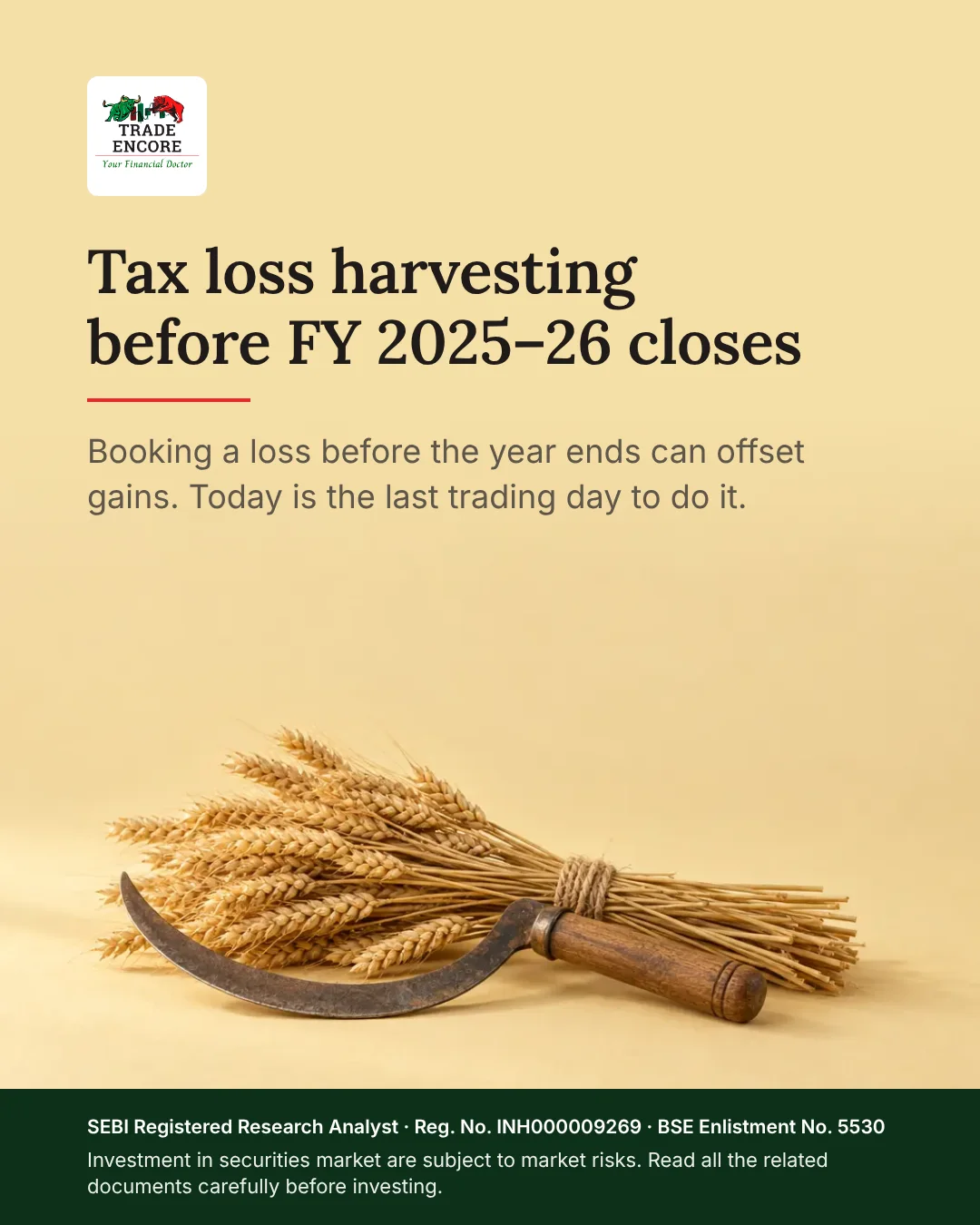
As the financial year 2025–26 rapidly approaches its end, many investors are meticulously reviewing their portfolios. For those planning to optimize their tax situation through strategic moves, today, March 30, 2026, is a critical deadline. This is effectively the last trading day for FY 2025–26 for transactions involving listed shares or equity instruments through the stock exchange, as March 31, 2026, is a stock market trading holiday on the NSE calendar. Missing this window means missing a crucial opportunity for tax loss harvesting for the current financial year.
What is Tax Loss Harvesting and Why is Today Important?
In simple terms, tax loss harvesting is a smart financial strategy where you sell a loss-making investment before the financial year ends. The primary goal is to "book" this loss, which, under income-tax rules, can then be used to reduce your taxable capital gains. Think of it as balancing your books – using your investment losses to offset some of your investment profits, thereby potentially lowering your overall tax bill.
The urgency today stems from the market holiday tomorrow. Any trade executed today will settle within the current financial year, allowing the capital loss to be recognized for FY 2025–26. If you wait until April 1st, 2026, any loss booked will apply to the next financial year (FY 2026–27), which might not be ideal if you have gains to offset in the current year.
Understanding Capital Gains and Losses: The Basics
Before diving into the rules, let's quickly recap capital gains and losses:
- Short-Term Capital Gain (STCG) / Loss (STCL): Arises from selling equity shares held for 12 months or less.
- Long-Term Capital Gain (LTCG) / Loss (LTCL): Arises from selling equity shares held for more than 12 months.
The tax treatment for these differs significantly, and this difference is at the core of effective tax loss harvesting.
The Golden Rule of Tax Loss Harvesting: Flexibility vs. Restriction
Under the income-tax set-off rules, there's a fundamental principle you must keep in mind:
Short-term loss is flexible. Long-term loss is restricted.
This single line encapsulates the core of how you can utilize your capital losses against your capital gains. Let's break this down with specific scenarios.
Case 1: You Made a Short-Term Profit
Suppose you've had a good year with some quick wins, resulting in a short-term capital gain. To reduce this gain using tax loss harvesting, you need to book a short-term capital loss.
Example:
- Short-term gain: ₹100
- Short-term loss booked today: ₹100
- Net taxable capital gain: ₹0
This is a straightforward adjustment. However, here's a crucial point:
If you book a long-term loss of ₹100, that will not reduce this short-term gain. Long-term capital loss cannot be set off against short-term capital gain.
This highlights the 'restricted' nature of long-term losses.
Case 2: You Made a Long-Term Profit
What if your portfolio has yielded substantial long-term profits? Suppose you made a long-term capital gain of ₹100 this year. Here, you have more flexibility:
Option A: Book a long-term loss
- Long-term gain: ₹100
- Long-term loss: ₹100
- Net taxable capital gain: ₹0
Option B: Book a short-term loss
- Long-term gain: ₹100
- Short-term loss: ₹100
- Net taxable capital gain: ₹0
So, when the gain is long-term, either a short-term loss or a long-term loss may help reduce your tax liability. This demonstrates the 'flexible' nature of short-term losses.
Case 3: The Common Mistake Many Investors Make
A frequent misconception among investors is that any loss can reduce any gain. This is simply not correct, and understanding this distinction is vital for effective tax planning.
Here is the simple truth to remember:
- Short-term gain can be reduced by short-term loss.
- Long-term gain can be reduced by short-term loss or long-term loss.
- Short-term gain cannot be reduced by long-term loss.
Always keep these rules in mind to avoid errors in your tax calculations and to maximize the benefits of tax loss harvesting.
What if the Loss Cannot Be Fully Used This Year?
Sometimes, the capital loss you book might exceed your current year's capital gains. Don't worry, the benefit isn't lost. If the loss cannot be fully used this year, it can generally be carried forward for up to 8 subsequent assessment years. This carry-forward is subject to certain conditions, primarily that you must file your income tax return by the due date for the year in which the loss was incurred. This makes tax loss harvesting a powerful long-term strategy, not just a year-end scramble.
What Should an Investor Do Today?
With today being the last effective trading day for FY 2025–26, it's time for a swift, yet thoughtful, review of your portfolio. Before you decide to sell any loss-making assets purely for tax reasons, ask yourself these crucial questions:
- Do I actually want to exit this investment? Is the company's fundamental outlook still weak, or has my investment thesis changed?
- Is the loss worth booking now? Does it align with my overall financial plan and current year's capital gains situation?
- Do I have capital gains this year that can be adjusted? Without gains, the immediate benefit of booking a loss is diminished, though it can still be carried forward.
- Am I making a tax decision or an investment decision? Ideally, tax loss harvesting should complement sound investment decisions, not dictate them.
Tax loss harvesting works best when it supports portfolio discipline. It should not become a reason to make a rushed or poor-quality exit.
This is especially relevant today because, for exchange-traded execution within FY 2025–26, today is the last available trading day before the year-end holiday on 31 March 2026. A hasty decision could lead to selling a good asset at a loss just for tax benefits, only to regret it later.
Final Takeaway for Today
If you have realized capital gains this year and also hold some loss-making investments in your portfolio, today is indeed the right time to review them. A well-timed tax loss harvesting strategy can significantly impact your net taxable income and overall financial health. However, always remember to balance tax efficiency with your long-term investment goals.
Remember the simple formula:
- Short-term loss can help in more situations. It can offset both short-term and long-term gains.
- Long-term loss helps only against long-term gain. It is restricted in its application.
Act wisely and promptly, keeping both your tax obligations and investment strategy in mind. For personalized guidance, consider consulting a SEBI Registered Research Analyst like Trade Encore.
Disclaimer: This blog is for educational and informational purposes only. It does not constitute investment advice. Investment in securities market are subject to market risks. Read all the related documents carefully before investing. Trade Encore — SEBI Reg: INH000009269